I Spent $3,000 on Dandruff Shampoo Before Someone Told Me What the Back of the Bottle Actually Says
Why "it works for two weeks and then comes back" was never your fault — and what the directions on your own shampoo quietly admit.

Go and get your dandruff shampoo.
I'm serious. Go and get it. I'll wait.
Got it? Good. Now don't read the front. The front is marketing — "clinically proven," "fast relief," "up to 100% flake-free." Everyone reads the front.
Turn it over and read the directions.
Somewhere near the bottom, past the lather-rinse-repeat, you'll find a line that reads something very close to this:
Read that middle phrase again.
To prevent recurrence.
That bottle — the one you have paid for over and over for years — is telling you in its own directions that the problem comes back.
That isn't a warning. That's a specification.
Eleven bottles, and every single one of them worked
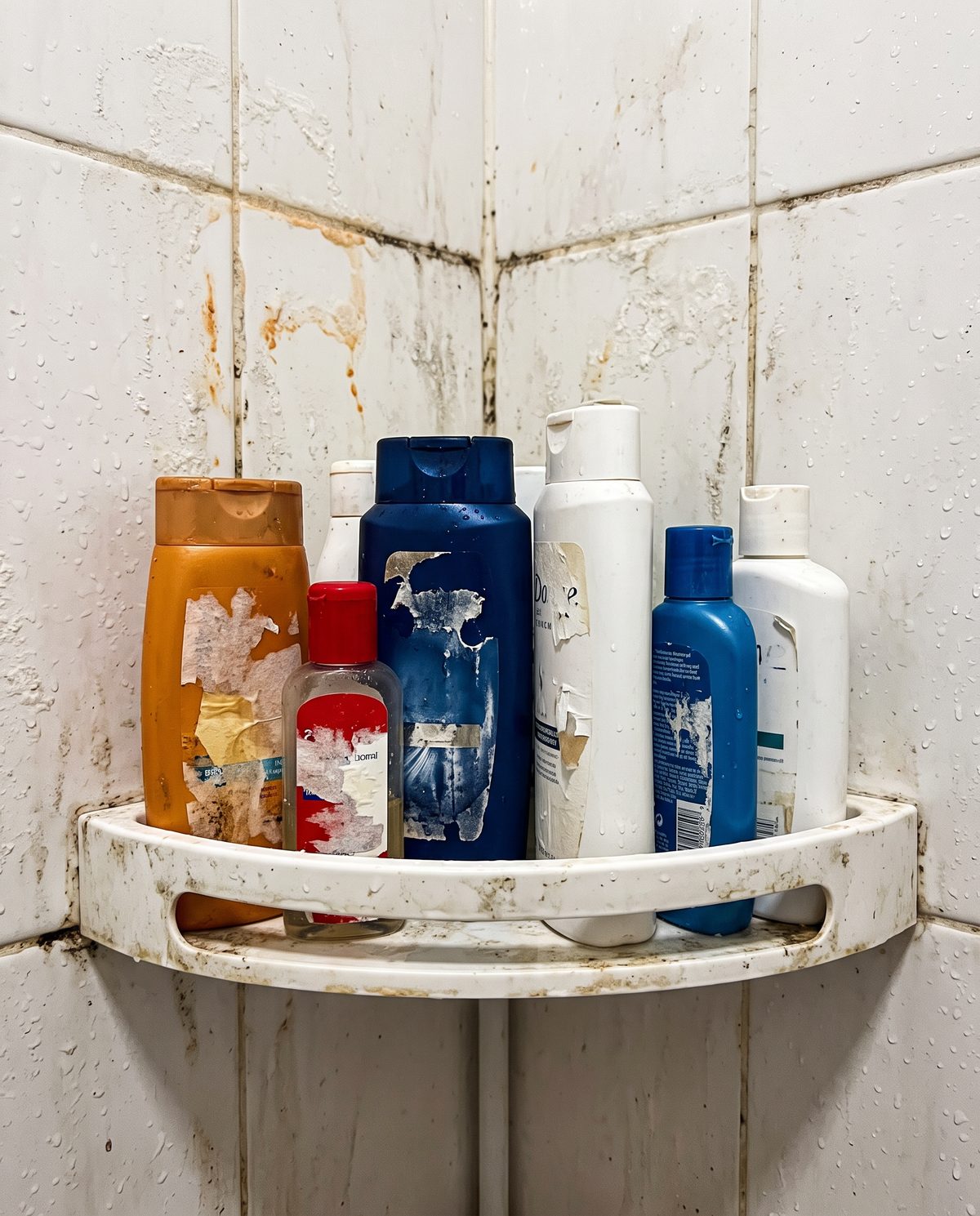
I counted mine on a Sunday night, which I don't recommend as an activity.
Two ketoconazole, one nearly empty. Selenium sulfide. Coal tar, which smells like a road being resurfaced. Zinc pyrithione for the quiet weeks. Two tea tree things. A salicylic acid scrub. Something with piroctone olamine my sister brought back from France. A steroid lotion from the doctor for the bad flare-ups. And a spray bottle of apple cider vinegar, because at some point everybody tries that.
At around $16 a month, on and off, since I was twenty-seven, that's about $3,000. On shampoo.
And here is the part that took me nineteen years to actually hear.
Every single one of them worked.
That's not sarcasm. The ketoconazole works. Every time I used it properly, my scalp calmed down, the flaking dropped away, and for ten days to a fortnight I was fine. That is precisely why I bought it again. And again. And about a hundred and forty times after that.
What I never once got, in nineteen years, was a week where I didn't have to.
See what an oral protocol looks like instead →What is actually happening up there
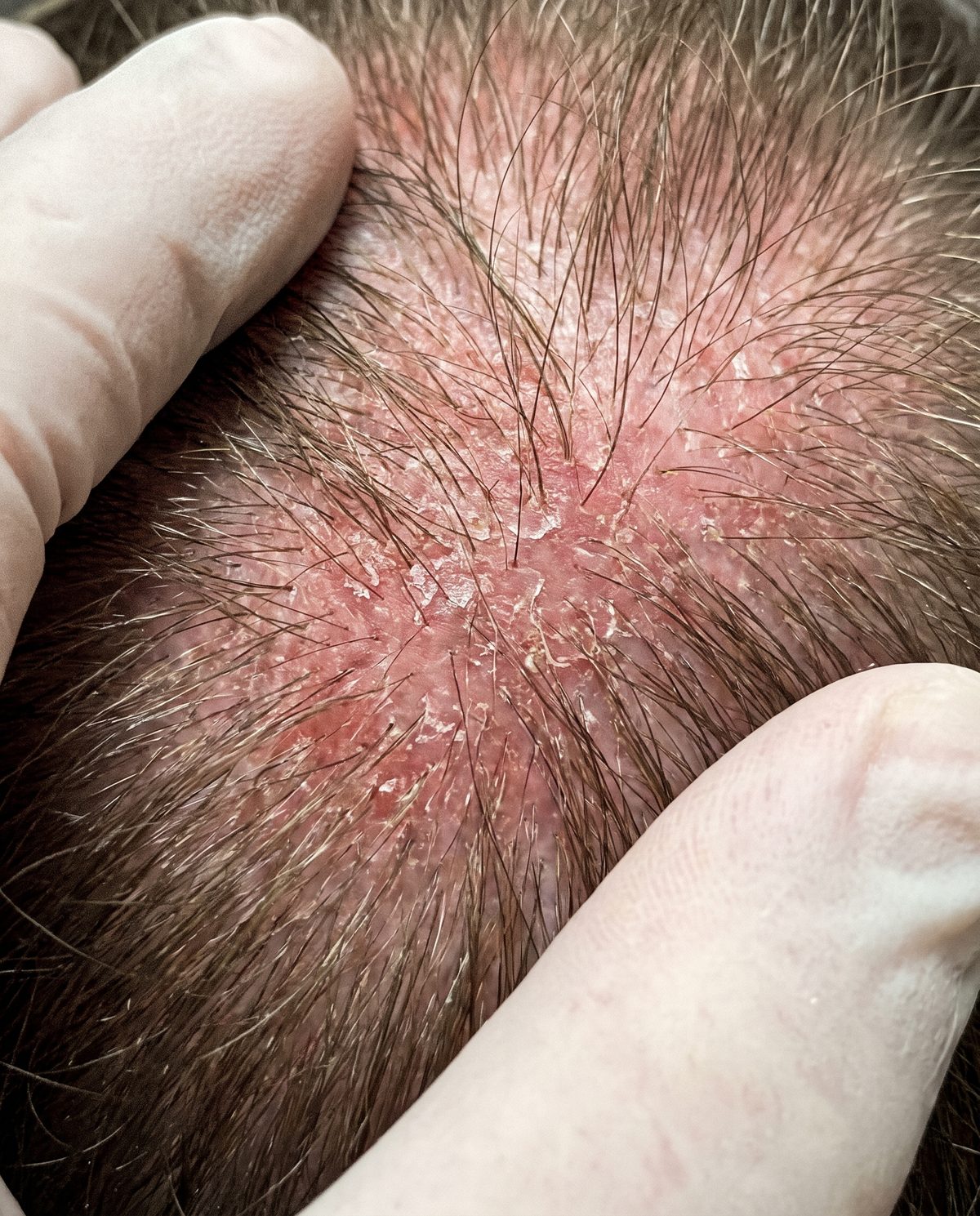
There is a yeast called Malassezia. It lives on everybody's scalp — yours, mine, people who have never had a flake in their life. You don't catch it, and it has nothing to do with being clean. That last part matters, because most of us spend years washing more and more often, and washing harder has never once fixed this for anyone.
It feeds on the oil your skin produces.
In most people, nothing happens. In some of us, the immune system reacts to what that yeast leaves behind as it feeds.
The scalp inflames.
And inflamed scalp skin turns over far too fast. Instead of shedding cells you can't see, you shed them in pieces you can.
That's the snow on your shoulders. The flakes aren't the disease. They're what's left over.
Now here is the part that reorganised my head.
The oil feeds the yeast. The yeast provokes the immune response. The immune response inflames the skin. And inflamed skin produces more of the very thing the yeast is feeding on.
It's a loop that keeps itself running.
Which finally explained the thing that had made me feel like I was losing my mind for two decades: I could wash my hair at seven in the morning and be flaking by half nine. I wasn't washing it wrong. I was clearing the evidence while the machine that produces it carried on running underneath.
Why a shampoo structurally cannot finish this
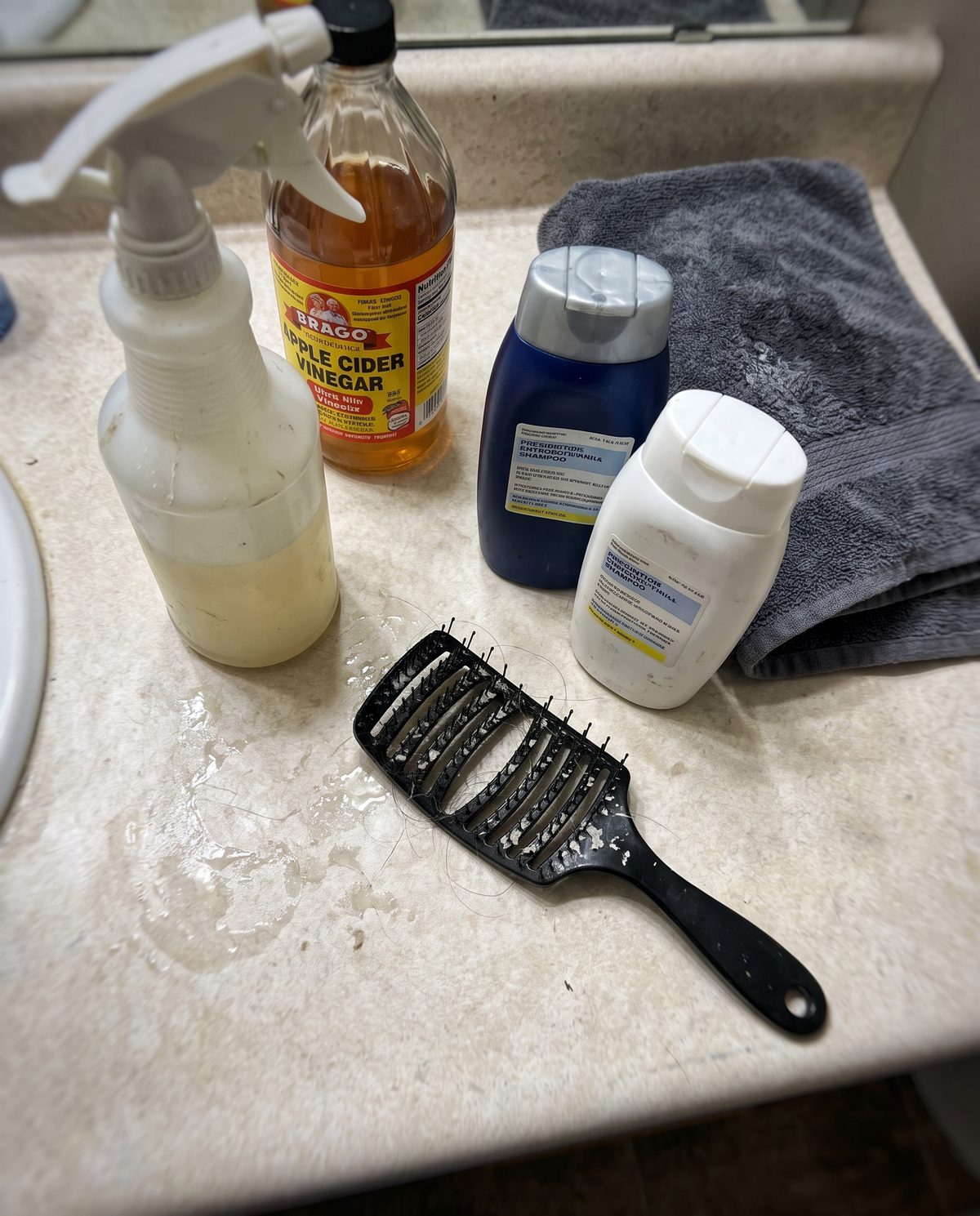
Antifungal shampoo goes in and lowers the amount of yeast on the surface of your scalp. Genuinely. Properly. That's why it works.
What it does not touch is the oil your body keeps producing, or your immune system's reaction to the yeast living in it. Those two things are what let it overgrow in the first place — and neither of them is sitting on the surface where a bottle can reach.
So it grows back. On schedule. Which is why the directions say what they say.
Think about a leak in a flat roof. You can mop that floor every morning for a year and the floor will be dry every morning. You have not fixed the roof. You have become a man who mops.
The medicated shampoo is the mop. And the frequency on the back of the bottle isn't a detail — the frequency is the treatment. Take the frequency away and there is nothing left.
Which is why buying a stronger one has never helped anybody for long. A stronger antifungal kills more yeast on the surface. It is still on the surface. Stronger doesn't fix a location problem.
This is the route that isn't a shampoo →The study nobody mentioned in nineteen years
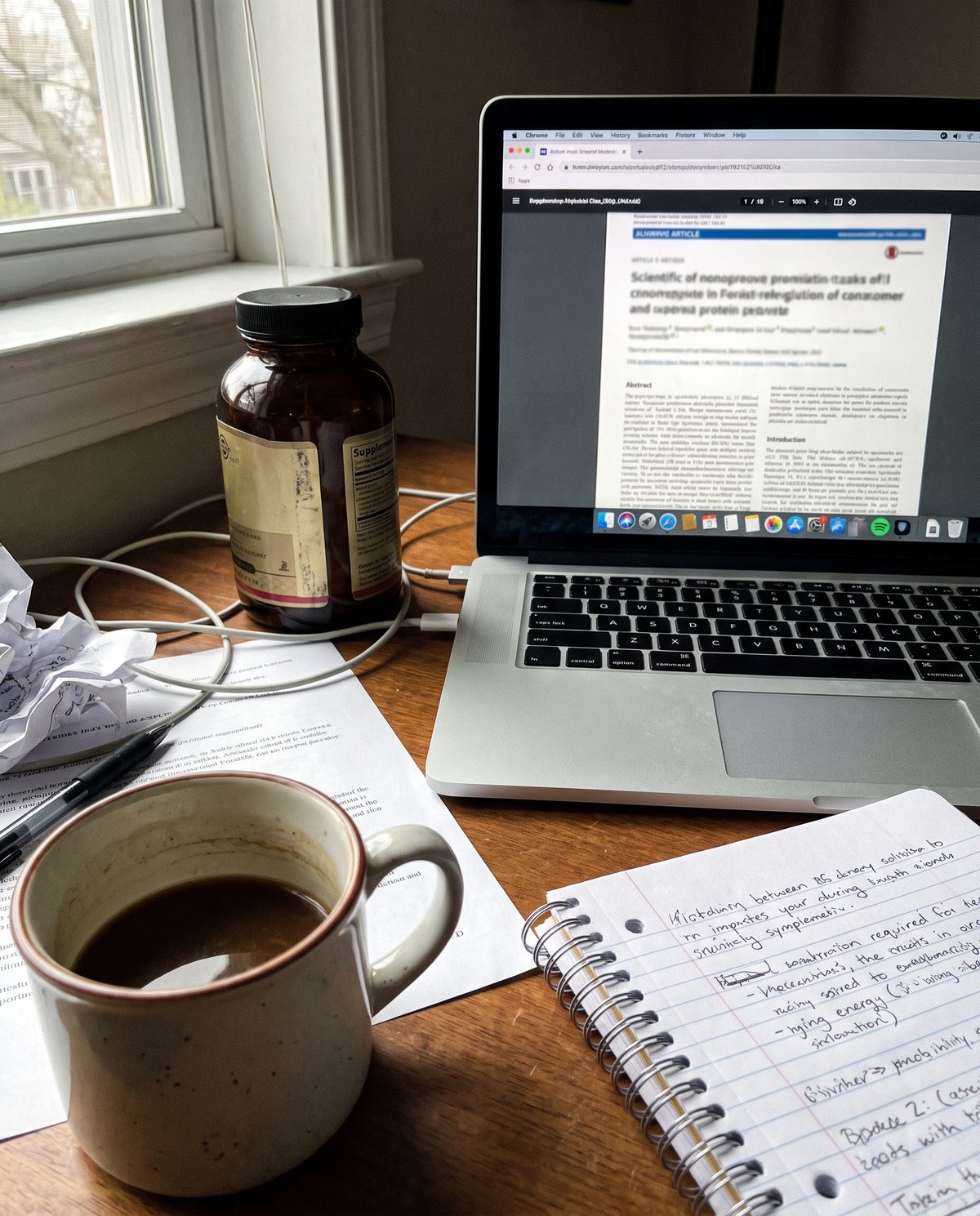
I stopped looking for a better bottle and started looking for a different place. And what I found was a piece of research from 2017, published in a journal called Beneficial Microbes.
Sixty men with moderate to severe dandruff. Placebo-controlled. Half of them were given an oral probiotic — swallowed, not applied. Nothing antifungal went onto anybody's head at all.
After 56 days, the men taking it had significantly less flaking, less redness, and lower overall severity than the men on placebo.
I read that on my phone at half past midnight and sat up in bed.
Not a stronger mop. A different room entirely.
What a scalp protocol actually has to contain
Here's where most people go wrong when they try this themselves — and I tried it myself first, with a $12 probiotic from the supermarket, and got precisely nothing.
A standard probiotic is built for digestion. There is no antimicrobial component in it at all, most are a "proprietary blend" with no strain IDs printed so you can't compare them to anything, and nothing in them touches the skin barrier. It's the right idea aimed at the wrong organ.
This condition runs on three things at once, so a protocol has to cover three layers.
That's InnaDerm. Three capsules, once a day, in a single sachet. Nothing goes on your hair, nothing has to be timed, nothing has to be rinsed out.
What happened over the next eleven weeks
I'm not a doctor and I'm not going to tell you anything I can't stand behind. So here is only what I noticed, and when.
Week 1Nothing. If I'm honest I was annoyed about it and half-expected to be writing this off as bottle number twelve.
Week 2My pillowcase. I have turned my pillow over every morning for the best part of twenty years, before my wife gets up. On the Wednesday I did it out of pure habit and there was nothing on it worth hiding.
Week 3My hands. I hadn't clocked how often I was at the back of my head during the day until the week I stopped doing it. Not less. Stopped.
Week 5I washed my hair with ordinary shampoo, because I'd run out of the medicated stuff and hadn't replaced it. No five-minute wait, no timer. And there was no flare by Friday.
Week 7I stopped putting a dark towel on the pillow.
Week 11I threw eight bottles in the bin. I kept three, because I've been let down before and I'm not daft.
Who this isn't for
- Anyone wanting overnight results. The timeline above is the honest one.
- Anyone who wants a cure. It isn't one, and the flaking can return if you stop — the difference is where it's being addressed from.
- Vegans and vegetarians — the softgel is gelatin-based.
- Anyone who has never actually tried a medicated shampoo. Try the $12 solution first. Genuinely. Come back when you've read the directions on the back.
InnaDerm — Gut & Skin Support
- Three-layer daily protocol — antimicrobial, microbiome, barrier
- Seven named strains at 20 billion CFU, strain IDs printed on the label
- 3 capsules once a day — nothing applied to your hair or scalp
- 30 sachets per box
- 90-day money-back guarantee
If it does nothing in three months, send back what's left and you get your money back. No phone call, no argument. That guarantee is the only reason I ordered at midnight instead of talking myself out of it for the twelfth time.
One last thing. Go and put that bottle back. But read the directions once more before you do, because once you've seen that line you can't unsee it, and it explains nineteen years better than any doctor ever did for me.